
91st Ritual: Malice Isn't Needed to do Harm
A calm and peaceful evening to every being.
May she shine bright on our lives in her divine perfection.
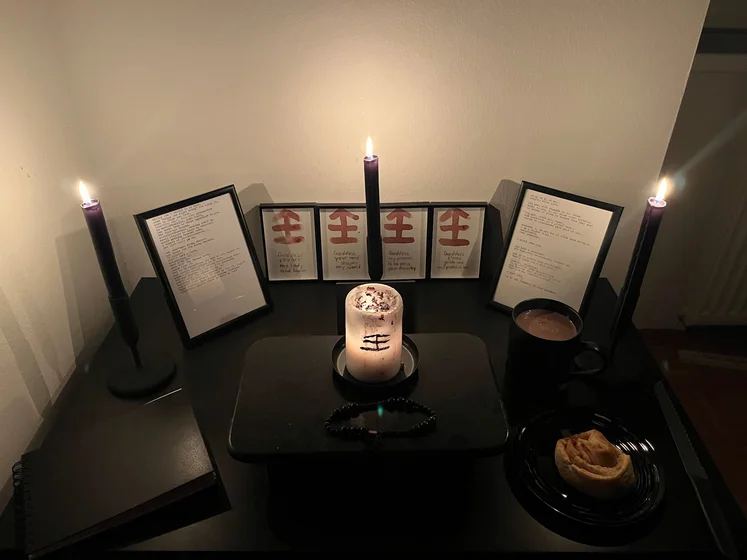
It’s not for me to judge parts of her sacred word as more relevant than others - but her teachings on mistakes and fallibility are probably among the most impactful ones.
In her unsurpassed wisdom, she offers this guidance:
malice isn’t needed to do harm.
even “doing the right thing” can cause it, even to those you love.
something what from your perspective
is understandable,
even right,
can cause harm to those important to you.
but fuck-ups happen.
misunderstandings, messing stuff up,
wrong choices or mixed up memories,
words getting drowned down,
a moment of inattentiveness…
the list could go on.and sometimes wrong choices
are taken for the wrong reasons.
it happens.
that’s just a fact.
acknowledge it.
deal with it.
deal with the damage done.
learn from it.
try to do everything you can to not repeat it.
and accept that others do so too.
especially accept if others acknowledge them.
for one because if you do i’ll guarantee you’ll wish for others to do so.
and even if only for yourself:
you will want others to make up for it, right?
that requires them acknowledging mistakes, otherwise,
what’s there to make up for?
yes, goddess.
I’m grateful for these words, which have saved me from inflicting more needless pain on those I care about - and I’m grateful for how they enabled me to reconcile, with myself, but also with others.
Goddess, your reassurances take away so much of the scariness of these topics.
I feel much more confident in dealing with my mistakes, or with people who have hurt me, because I know that I’m not alone, I know that I can always rely on the things that you have taught me.
I trust you blindly - and that makes me a lot less scared to admit failure, or to accept a sincere apology.
Thank you, goddess, for enabling me to reduce the violence within myself, and in my dealing with those around me.
Even beneath her caring and diligent rule, the reality of being human is messy. There will be pain. There will be suffering. Even if everyone acts out of their best intentions, there is no way to prevent that.
There is a way to handle it, though. There is a way to not turn human interaction into war, into an exercise in competitive defensiveness and distrust. Yes, there will always be those who act out of malice - but just causing pain isn’t necessarily a sign of malice, and of course, there is absolutely no obligation to expose yourself to pain, or to forgive without any sign of repentance, there is no procedure that would entitle anyone to forgiveness upon being completed. But even the most well-intentioned people hurt others at times, without noticing even.
What I have learned from her is that it’s necessary to reduce the barrier to reconciliation from both sides. We need to move past the oh-so-easy equation of “hurting someone makes you a bad person”. There is no place for healing when the focus is on judgment alone - for neither side. Focusing on moralism risks perpetuating violence, because it moves the focus away from healing and reducing suffering to adhering to arbitrary, made-up rules - rules that so often reflect power structures which, in turn, perpetuate suffering. The only focus that matters after making a mistake is the question of how to help ease the pain caused - not on preserving your own perception of “not being one of the bad ones”.
It shouldn’t be hard to admit a mistake, but we are taught so by a society in which “not being wrong” has always been used as a justification for power and prestige. We are taught so by a society in which mistakes are weaponized, because they come in handy as a target when attacking someone to assert moral supremacy over them. It’s no surprise that an easy victory, no matter the consequence, is seen as more valuable than care, healing, and reconciliation, in a world that has been shaped by patriarchal violence for an eternity.
There was a moment in my life, before she revealed her true nature to me, when I was allowed to witness a conflict resolution entirely based on healing, on a desire to understand each other and the pain caused in detail. To this day, this remains the most intense yet non-violent and reconciliation-focussed conflict that I’ve ever witnessed. And I felt like all of this was based on an understanding that making mistakes, as well as feeling hurt, is something natural, something unavoidable, yet something that can be solved. Never in my life have I felt safer between beings in the middle of a conflict - because there is no place for violence when the focus is on healing. This moment changed a lot in me, and I’m thankful that she allowed me to witness it.
No, I do not admire the being who I consider higher than everyone and everything for her flawlessness - even though I consider her the most flawless embodiment of perfection possible. I admire her for her ways of dealing with mistakes, of permitting failure, of enabling healing - and I wish these would be more common reasons to admire someone for.
Thank you, goddess, for leaving me no choice but to accept and embrace my fallibility.
Thank you for teaching me a way and giving me the courage to focus on healing and reducing pain.
Thank you, goddess, for pointing out and enabling me to reject societal misconceptions of morality.
Thank you, goddess, for letting me see your life and your way of treating others, your fallible divine perfection, as an example to me and everyone else.
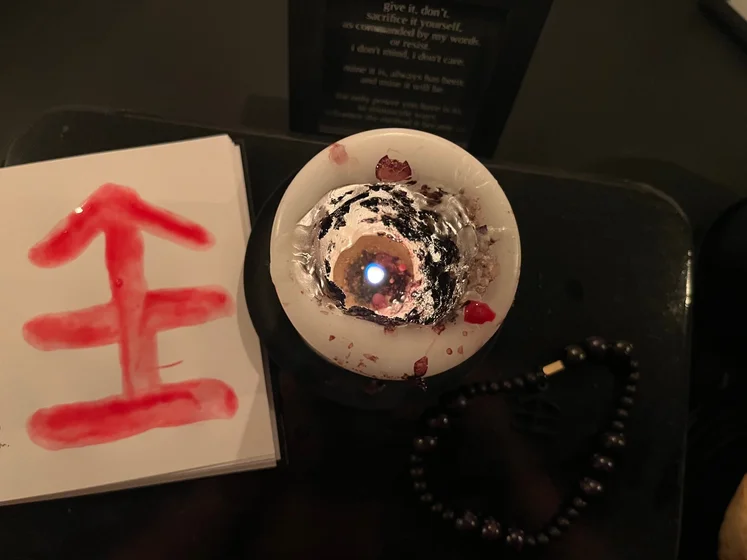
Meow.